
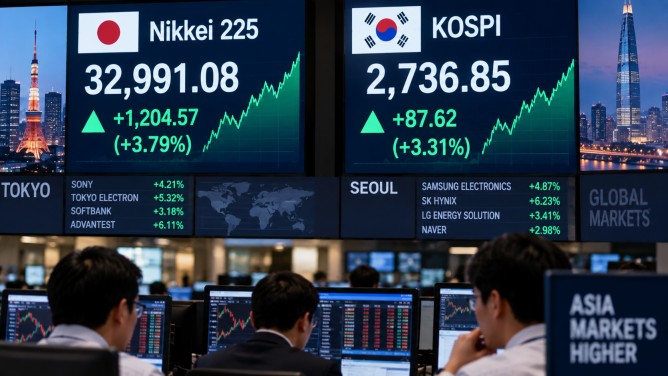
Stock markets displayed a mixed performance globally on Monday, with Asian indices leading the charge, spurred by robust activity in technology and semiconductor sectors. Japan’s Nikkei 225 climbed by 2.1%, while South Korea’s Kospi soared 4.6%, driven by significant gains in semiconductor powerhouses. Samsung Electronics and SK Hynix saw substantial increases of 5.7% and 8.1%, respectively. Other companies in the chip industry, such as Renesas Electronics, Rohm, and Tokyo Electron, also enjoyed notable upticks, underscoring sustained investor focus on AI and semiconductor firms, which continue to fuel the momentum in Asian equity markets.
Conversely, European markets experienced a more reserved session. France’s CAC 40 showed little movement, and both Germany’s DAX and Britain’s FTSE 100 saw minor declines. Across the Atlantic, U.S. stock futures indicated a weaker start; however, American markets remained closed in observance of Labor Day. In other parts of Asia, Hong Kong’s Hang Seng index decreased by 0.9%, while the Shanghai Composite remained stable. Australia’s S&P/ASX 200 managed a slight gain.
In currency markets, the U.S. dollar’s decline against the Japanese yen drew attention. The yen’s recent weakening has been a point of concern for Japanese officials, with keen investor interest in any forthcoming signals from the Bank of Japan regarding potential changes in interest-rate policy. Meanwhile, oil prices maintained their elevated status due to ongoing tensions between the United States and Iran, contributing to inflationary fears and affecting the broader economic forecast globally.
Market participants are also on the lookout for upcoming U.S. inflation figures and the Federal Reserve’s policy meeting slated for September, events that are anticipated to offer insights into future interest rate trajectories. The interplay of these factors continues to shape investor sentiment and market dynamics worldwide.